











Scented Story No. 3
If floral and sunny scents have enchanted you over the past few weeks, this new tale straight from the Middle Kingdom should be able to keep the magic alive... After the tiare flower and jasmine, it is time for the enigmatic blue rose.
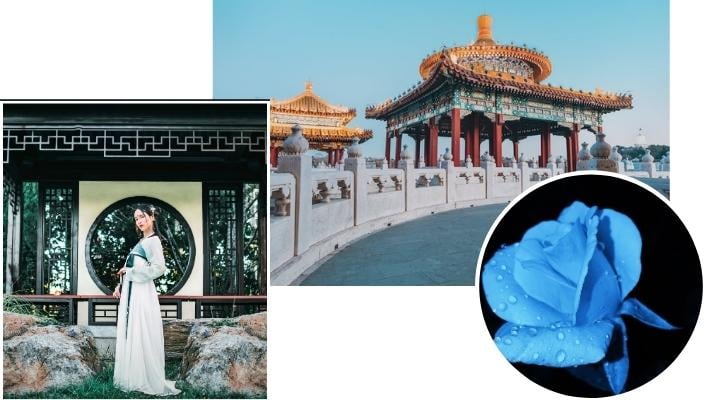
The blue rose – a Chinese tale
Once upon a time, there was a young princess endowed with every quality. Her deep blue eyes illuminated a lovely face, and everyone admired her intelligence. However, the princess had a tiresome habit: considering herself a perfect person, she demanded that everything around her be perfect as well. She would not hesitate to throw away a cake if the strawberries adorning it were not all the same size and color! Naturally, no suitor found favor in her eyes, and despite her father's insistence, she continued to reject all the young men who were presented to her. One day, as he begged her once again, she promised to marry whoever could bring her a blue rose. The emperor, who adored her and had denied her nothing since her mother's death, did not rejoice at this decision because he knew that blue roses did not exist. Roses were white, red, pink, or yellow, but never blue! Yielding nevertheless to this final demand, he had it announced throughout the kingdom that the first person to bring the princess a blue rose, the color of her eyes, would win her hand.
Many set out in search of this famous rose in the hope of marrying the princess. And just as many abandoned the quest. After several weeks, only three suitors presented themselves at the palace.
The first was a wealthy merchant. He had gone to find the best florist in town, promising him a well-filled purse if he found him a blue rose, but also death if he failed. Desperate, the florist, on his wife's advice, went to find an alchemist who dipped a white rose in a blue liquid the color of the princess's eyes. The petals immediately took on a fabulous blue hue. Delighted, the merchant ran to the palace to present his rose. The emperor, very satisfied, asked the princess to keep her promise, but she, far from foolish, asked for a bird to be brought. When it landed on the rose, it died instantly, killed by the poison that had been used to color the flower.
“Father, how could you let yourself be fooled like this? This rose is only blue because it has been dyed; it is not its original color. How could I accept a fiancé so unreliable, so insincere, so dishonest? He will deceive me just as he tried to deceive you! I will not marry this man.”
The second suitor was a soldier who had traveled the world. From the region of the five rivers, famous for its diamonds, he brought back a blue sapphire with a beautiful sparkle. He took the stone to a jeweler who had it cut in the shape of a rose before bringing it to the palace. When the emperor saw the jewel, he found it simply perfect and was convinced that his daughter, this time, would agree to marry.
Unfortunately, when she saw the jewel, the princess did not have the expected reaction: “Father, this is not a flower, and you know it. What do I want with a fake, artificial love, a showy love? I am not a woman to be bought. I am still waiting for someone to bring me a real blue rose.”
The third suitor was a young nobleman from a good family. He summoned the most renowned painter in the country and asked him to paint the prettiest blue rose imaginable on the finest Chinese porcelain. When it was finished, the young nobleman brought the emperor a wonderfully translucent vase featuring, in its center, the most perfect representation of a blue rose. Convinced that his daughter would be seduced by such delicacy, the monarch sent for the princess and said to her: “This time, you have the blue rose you wished for; you must keep your promise!” To which the princess replied: “Father, I want a living rose, not an image, however beautiful it may be. I will therefore keep the vase, but not the suitor!” The last suitor was thus dismissed, like all the others.
One summer evening, while admiring the sunset, the princess heard a poet singing. He was a handsome young man with a soft and harmonious voice. She went down to meet him. One look was enough. His voice and his words had already won her over. When he told her he wished to marry her, she replied: “Alas, I have sworn that I will only marry the one who is able to bring me a blue rose, and until now, no one has succeeded.” The poet promised he would succeed because “there are blue roses everywhere for those who wish to see them.”
The next day, the young poet appeared at the palace with a cream-colored rose. This made the emperor smile, disillusioned by this endless quest for the perfect suitor. He nevertheless sent for his daughter and said to her: “Here, my daughter, is a poet who claims to have found a blue rose!” To his great surprise, the princess took the rose and asserted, without a hint of hesitation: “Indeed, Father, this rose is blue, and it is as beautiful as life itself.” Everyone at Court shared the emperor's astonishment. Everyone saw a cream-colored rose, not a blue one. Then the princess, sure of herself, continued: “It is your eyes that deceive you! Look closely, look better, and you will see that the rose has the color of my eyes, a wonderful blue.” No one dared to protest anymore, and the emperor was certainly not going to argue, too happy to have finally found his son-in-law. The princess then married the poet. Songs, laughter, poetry, and music soon filled the Palace, and the princess, finally satisfied with the essentials, ceased to seek perfection in all things.
Sources:
La rose bleue, Chinese tale, taken from the work of Rè and Philipe Soupault: Histoires merveilleuses des cinq continents, Ed Seghers, 1975, 1985, p. 185-188.