







Secrets behind our scented candles
For centuries, candles have been a part of our homes. Once functional, they now play a unique decorative, warming, and fragrancing role. We are familiar with them, we love lighting them, and even more so for special occasions. In short, we think we know them well.
But did you know that behind these everyday objects, more than 7 talents combine their expertise, working together from design to production? Who would have thought that more than fifteen steps are necessary for the development of our scented candles?

1st step: Scented candle development in the laboratory
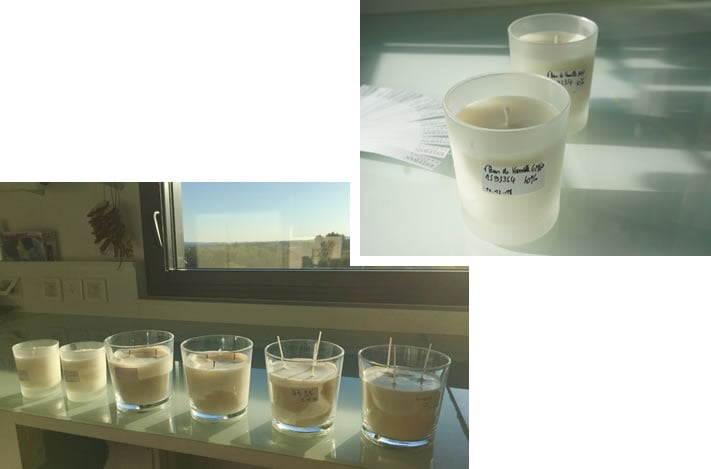
The creation of each Estéban candle begins in the application laboratory. For each of our fragrances, the lab team conducts tests to identify the dosage of all the elements composing the formula so that the scent is as true cold as it is hot.
The scent on the candle must also be as faithful as possible to other media you may use (scented diffusers, room sprays, concentrates…).
In addition to fragrance note fidelity evaluations, performance (intensity and duration) and burn quality measurements are added to achieve the best possible result. For this, the team custom-pours the candles and has calibrated test rooms to evaluate them.
And it is to our Research & Development team in this same lab that we also owe the quality of our 100% natural wax, composed of a clever blend of several plant-based waxes. More than 3 years of research were necessary for its development. Paraffin-free, our wax contains no petrochemical derivatives. Thanks to the high quality of its raw materials and its 100% cotton wick, it burns with little smoke and a minimal soot index. It therefore allows for the best possible combustion. However, the secret of its composition is carefully guarded, so we will not say more.
2nd step: Wax manufacturing
Once the "precise recipe" for each scented candle is optimized, we can move on to manufacturing, specifically to the melting pot where the different waxes are mixed. Introduced in solid form (as flakes or small cubes), waxes have very variable melting points depending on their nature. This is why our wax experts introduce them one by one, gradually, and meticulously control the temperature, carefully studied to obtain a perfectly homogeneous consistency. One day is necessary to obtain a high-quality mixture.

3rd step: Manual wick positioning
Then, our wax experts manually place each wick in the empty glasses. To glue the wick, they use unscented virgin wax, so as not to introduce any glue.
Thus, each wick is dipped in virgin wax and then positioned in the center of the glass. Centering is both aesthetic and essential for a quality burn. If the wick is not centered throughout its height, the candle will eventually hollow out as it burns.

4th step: Scenting the wax
The mixing of wax and fragrance is carried out in a tank equipped with an agitator allowing a good osmosis of the materials.
Did you know that with each fragrance change, the tanks are cleaned with high-temperature virgin wax? This way, we protect our wax and our fragrances from any disturbance.
5th step: Two-stage pouring of scented candles
Pouring can now begin. Our wax experts position the pouring heads above the candle tray and pour 80% of the candle's contents.
It is then necessary to re-center, after partial solidification, each of the wicks by hand, always to aim for perfect combustion.

6th step: Drying & finishing
Placed under an extractor hood, the candles return to an ideal temperature. The color of the wax then naturally becomes white. Indeed, we do not introduce any dye into our wax.

For certain special productions, the wicks are then trimmed by hand so that the burn quality is optimal from the very first light.
7th step: Scented candles off to packaging
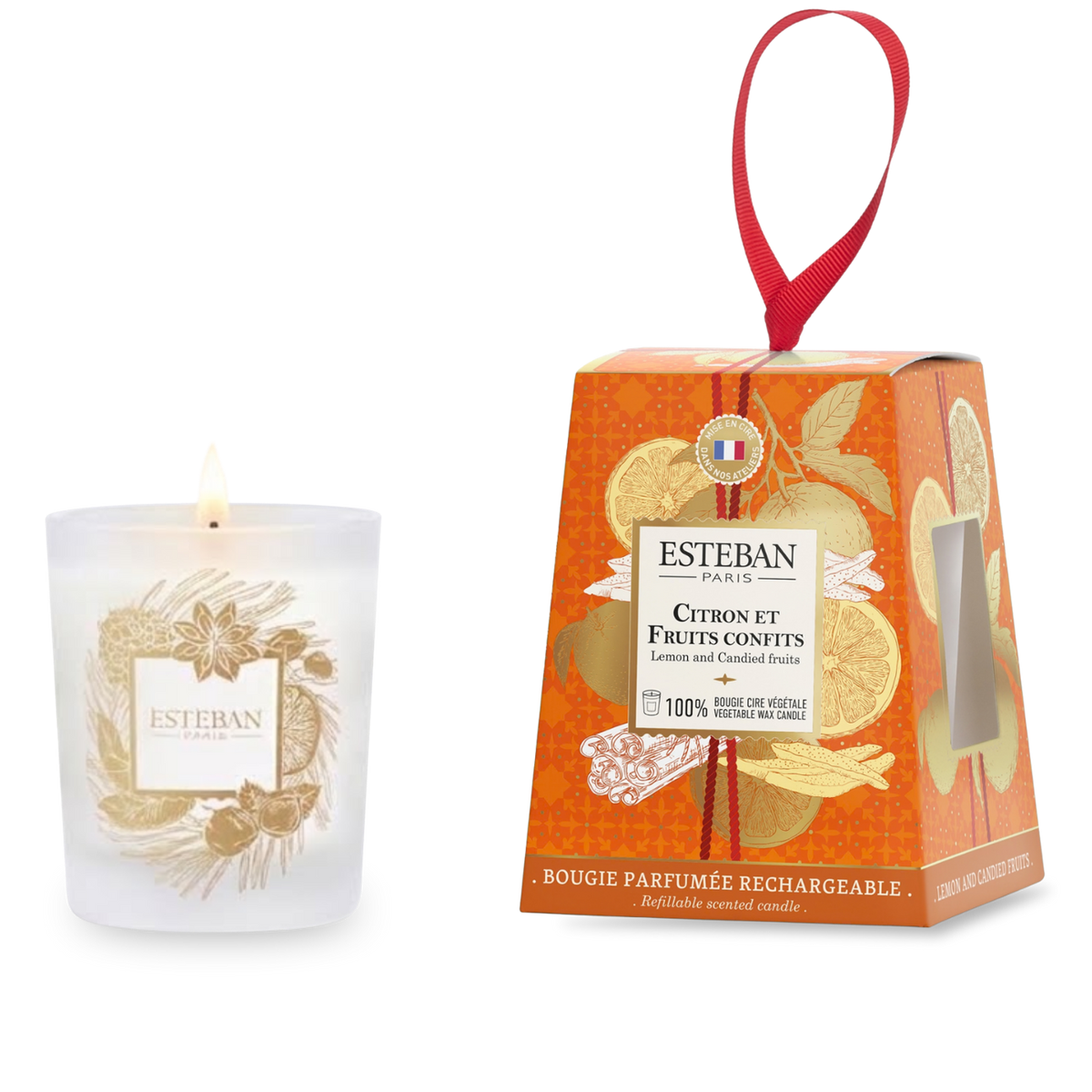
After manufacturing, the semi-finished products are taken to the packaging workshop. Depending on the collections, the candles are labeled, a blotter is added. Our teams put our candles in cases so that the charm operates from the first visual contact. Colorful, graphic or narrative, the case already tells you a lot about the candle's fragrance. They are then packaged and ready to offer you precious scented moments!
And the Scented Candle Refill?
Let's not forget our scented candle refill. It has become an essential item for many of our fans, allowing them to refill their candle endlessly. You can also give a second life to the refill lid with a detailed DIY tutorial.
Environmentally friendly and economical for the consumer, it is nevertheless produced with the same high standards throughout the manufacturing process. Our wax experts will tell you that its most delicate point in production is the manual placement of the wick, which requires particular attention for good adhesion to the container. This is also part of their manufacturing secret, and always made in France, in our workshops, of course.

Portrait of Jean Paul, Wax Expert
In the laboratory, as in the factory, our expertise has developed over the years thanks to the high standards of our teams. The added value and quality of our scented candles come not only from expertise but also from their experience.
As such, Jean-Paul is a perfect testament to our know-how culture. For over 25 years, he has worked in Estéban's production department.
Having become a specialist in waxing our candles, he is one of our oldest wax experts and agreed to a short interview:
In your opinion, what is one of the most delicate steps in the manufacturing of our scented candles?
Although very quick, centering the wick remains a decisive step. If the wick is not centered throughout its verticality, the candle risks hollowing out as it burns, which will make it partially unusable.
Consequently, I constantly keep an eye on all the candles and we intervene several times to reposition each wick by hand.
After so many years, what do you enjoy most about your job?
What I like most is being able to be the first to test new fragrances, to discover new products. Even though I make them, I'm still amazed by what they release.
Do you have a favorite scented candle?
Yes... I particularly appreciate, and have for a long time, the Esprit de Thé scented candle. It remains my favorite. At home, I have it in several places. I appreciate it when my loved ones come over and notice its delicate scent. Plus, I usually leave some unlit, because they diffuse even when cold.
Many thanks to Jean Paul and the laboratory teams and wax experts for their contribution to this article.