

















The Kōdō ceremony, or the art of incense in Japan
There are civilizations whose codes and traditions span the ages. Japanese civilization is one of them. Renowned for its refinement, precision, and delicacy, Japanese culture holds hidden treasures that only a handful of initiates know, master, and perpetuate. Thanks to the strong ties that unite it with Nippon Kōdō, a Japanese incense brand since 1575, Estéban had the privilege of attending one of the most confidential rituals: the kōdō ceremony (literally, "the way of incense"). This ancestral art based on olfaction and concentration was once practiced by samurai before a battle, Zen monks, and a few members of the Imperial Court. A look back at a fascinating and intimate initiation…
The birth of a Kōdō art:
The kōdō ceremony is considered the third (and probably the most difficult) of the three traditional Japanese arts, behind the flower ceremony (kadō) and the tea ceremony (chadō). This activity, simple in appearance (smelling and appreciating the fragrance emanating from heated precious woods), is highly codified: words, gestures, and attitudes have a very precise role, inherited from several centuries of practice (likely formalized around the 16th century, although incense was introduced to Japan as early as the 6th century). Incense, in general, is an integral part of the Japanese art of living, whether it is used to perfume rooms and clothing or to pay homage to ancestors.
While the practice of kōdō enjoyed a certain popularity during the previous century, it is today particularly confidential, especially since its apprenticeship in Japan is provided by only two schools: the Oie school, with its very artistic approach, and the Shino school, with its more spiritual approach. Each of these schools has a single "grand master," a title and vocation passed down from generation to generation for 500 years, just like the raw materials they handle: some of the woods used in these ceremonies are centuries old. Imagine the emotion one can feel living the same sensory experience as a shogun*, a poet, or an aristocrat of the era. This is an emotional journey for which no one can be prepared.
*shogun: High-ranking samurai
The trail of a treasure:
The origin of kōdō is shrouded in mystery… Legend has it that a stump of scented wood – likely a jinko – washed up on the shores of Awaji Island in 595, and that fishermen, fascinated by the almost supernatural odor emanating from the fragments thrown into the fire, hastened to offer some to the emperor. Some of these woods, preserved for 1,000 years, still figure among the riches of the Imperial Court, where they continue to arouse admiration and envy. And for good reason, the precious woods used in this type of ceremony are true treasures: the price of the rarest essences can reach €850 per gram, which further adds to the prestige of this ceremony, reserved for major events and guests of honor.
Playing to learn how to smell:
The practice and discovery of kōdō most often take place through "games" that allow one to become familiar with the different essences of scented woods, with the goal of memorizing them. There are nearly 300 games, but the "Genji-ko" (the one we participated in) is certainly the best-known, as it is based on another monument of Japanese culture: "The Tale of Genji," a collection of 11th-century poems recounting the lives of the courtiers of that time.
Each chapter of this collection is illustrated visually by a calligraphic symbol and olfactorily by a combination of precious woods. Indeed, during the preparation of the game, the master of ceremonies chooses 5 different incense wood essences, cuts them into 5 pieces each, and then places the 25 fragments into paper envelopes. The 5 envelopes that will be used for the day's ceremony are then selected. Mathematically, there are thus 52 possible combinations of wood – as many as the number of chapters contained in The Tale of Genji (excluding the introduction and conclusion).
The goal of the game? To recognize the nature of each of the woods smelled thanks to their fragrance in order to state the correct combination (and thus, the correct chapter). The 5 pieces can come from the same wood, all be different, or be partially identical (some coming from the same stumps and others not). While the intrigue is stimulating, the task is nonetheless difficult…
Kōdō, A highly codified ceremony:
If we talk about "listening" to incense, rather than "smelling" it, it is to evoke the concentration necessary for this exercise, comparable to that which would be required by listening to a barely audible sound. The fragrance of these precious woods is so subtle that its appreciation takes place through a precise ceremonial that participants observe with the greatest respect.
The flow of the game
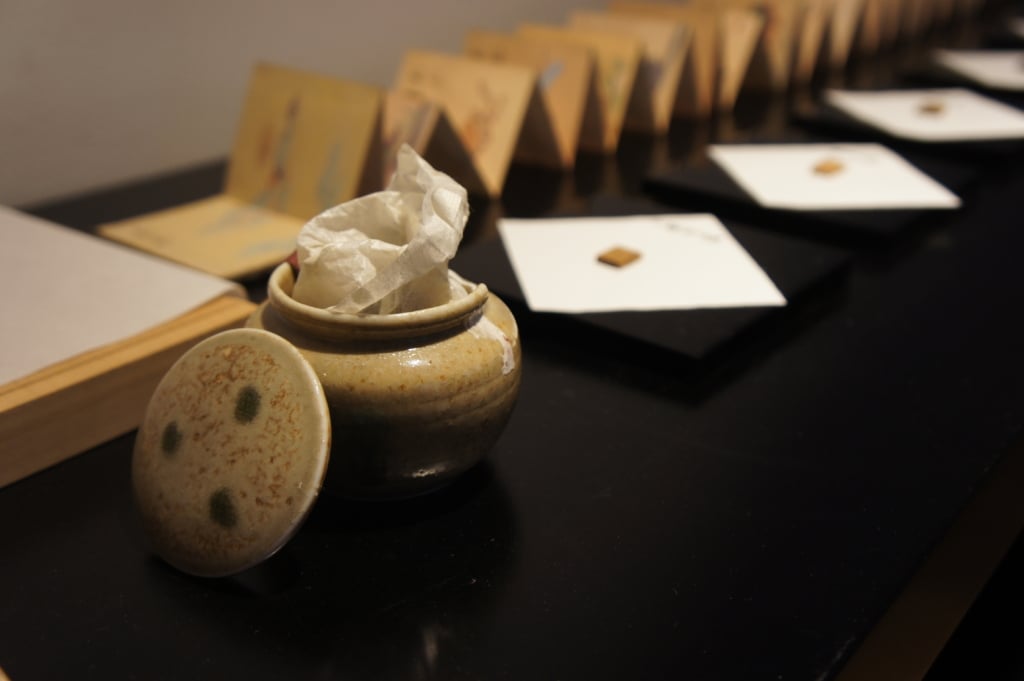
- To begin, the master of ceremonies prepares the incense burners that will house the wood fragments "listened to" during the session: ceramic containers inside which a piece of charcoal is placed, immediately covered with ash (to preserve its incandescence). Placed in balance on top of the ash dome, a mica plate serves as a base for the incense wood, which thus diffuses its fragrant trail without burning.
- Once the first incense burner is prepared, the master of ceremonies entrusts it to the first guest who "appreciates" it before placing it on a fabric square in front of him - a sign for the next participant that they may take the object themselves - and so on for all participants. Five incense burners circulate in this way in a precise order, until all the guests have become acquainted with the scented woods selected at random by the grand master.
- Master of ceremonies "appreciating" the fragrance of one of the incense burners before passing it on
|
The right gesture: To "appreciate" the incense at its true value, it is advisable to adopt a specific posture: > First, grasp the container with your right hand and place it on your left palm, > Make sure the "listening line"* of the container is facing you, > Cover the ash dome hermetically with your right hand, while leaving a space between your thumb and index finger to form a 'fragrance chimney' to your nose. > Finally, take 3 deep inhalations (and not one more) of the fragrance emitted, taking care to exhale to the side (always to the right), so as not to disturb the wisps of smoke |
- To finish, each guest gives their answer regarding the different woods smelled, by indicating on a pre-filled parchment the combination they believe they have identified – this via the famous calligraphic symbols (e.g., if the first 4 woods smelled seem similar to us, and the 5th is different, one must choose the symbol that shows the first 4 sticks connected at the top and the 5th stick all alone (reading from left to right)):
- All answers are then collected and recorded on a parchment by a calligrapher, who also tallies the points. The master then reveals the correct answer, and the participant who has received the highest score (that is, the greatest number of correctly identified wood essences) receives the parchment as a gift. An honor we had the privilege of receiving, thanks to the expertise of our team on site.
- Following this award presentation, the host of the ceremony greets all the guests, who also bow their heads, hands clasped, in a sign of deference. The kōdō ceremony is officially closed. Everyone leaves with a smile, delighted to have shared this moment of concentration and refinement, in the presence of other perfume enthusiasts. Might the greatest 'magical power' of incense be this ability to bring together individuals from all walks of life, in a shared moment of spirituality? Having lived this experience, we are intimately convinced…
Let's continue the emotional journey
The incense ritual, more than a tradition, is a true experience of the senses and the soul. With its great variety of Japanese incense, Estéban extends the refinement and renews your fragrant atmosphere infinitely. Our Japanese incenses are made in Japan from natural raw materials: spices, fragrant woods, roots, plants, and vegetable resins, among others, which are finely ground and then mixed with water and a vegetable binder. Their quality comes from a balance between ancestral know-how and more recent technological research. As it burns, incense has the power to create an atmosphere conducive to well-being and relaxation; once consumed, it leaves a fragrant trail for several hours. Keep this in mind for your next trip; the hotel room or vacation home will feel more familiar this way…


